
As the line between human creativity and machine output grows blurrier by the day, the need for reliable AI content detection tools has never been more urgent. From convincingly written articles to hyper-realistic synthetic images, the internet has become a vast ocean where authenticity is far from guaranteed. For regular users, journalists, educators, and e-commerce shoppers alike, the question "Is this real?" now accompanies almost every scroll. Fortunately, a wave of browser extensions has emerged to meet this challenge head-on, placing powerful detection capabilities right at your fingertips within Chrome. These tools do not replace critical thinking, but they offer a crucial first line of defense, scanning text, images, and even video in seconds. Over the last year, several standout extensions have proven their worth through extensive hands-on testing, and they have quickly become indispensable parts of the daily browsing experience.

One of the most focused options for text-based analysis is Copyleaks. Developed to spot content generated by models like ChatGPT’s creative variations, the extension adds a draggable quick-access menu to any webpage, keeping settings and a scan button always within reach. The workflow is intuitive but not entirely frictionless. A user first highlights suspicious text, at which point a small icon appears; a click populates the sidebar with the selection, and then a manual scan button click is required to trigger the analysis. While this extra step may occasionally be forgotten in moments of haste, the interface stays clean and unobtrusive. A notable friction point, however, is the mandatory account creation before the tool can be used. The free tier grants five credits\u2014each covering up to 250 words\u2014which can vanish quickly during regular verification sessions. For those serious about authentication, the Pro subscription opens access to roughly 25,000 words per month at a cost of $9.99, an investment that might be justifiable for writers worried about false flags or academic integrity. Yet Copyleaks exhibits a peculiar binary logic that frustrates many testers: it labels content as either 100% AI-generated or 0% AI-generated, with no probabilistic middle ground. In several documented cases, entirely human-written passages have been slapped with the "AI-generated" label, exposing the reality that even sophisticated detectors can hallucinate or misinterpret natural writing patterns.
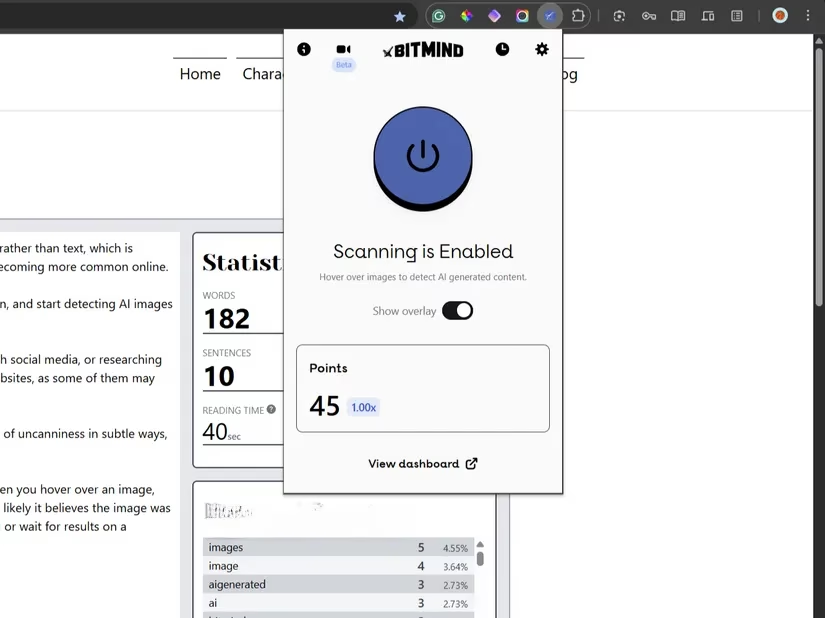
For image-centric verification, BitMind has carved out a reputation as a specialized ally. Unlike text-first tools, this extension focuses exclusively on detecting AI-generated visuals, a need that has exploded alongside the proliferation of tools like Midjourney and Stable Diffusion. No account setup is required\u2014it is truly install-and-play, operating anonymously right out of the box. While browsing photography portfolios, scrolling through social media feeds, or examining product listings on platforms like Etsy, where AI-produced stock is increasingly commonplace, a hover over any image triggers a percentage match in the top-right corner. This instant visual feedback, typically appearing within about 10 seconds, estimates the likelihood of synthetic origin. Field tests have shown BitMind’s accuracy oscillates between 70% and 80%, a respectable first-pass filter that hands a significant advantage to the user, even if it is not infallible. False positives do occur; genuine photographs, especially those with flawless lighting or surreal compositions, are occasionally flagged as machine-made. One documented example captured a completely authentic portrait being mistakenly classified, a reminder that the boundary between real and generated imagery has become exceptionally porous. Still, the tool shines when verifying sources, fact-checking breaking news images, or simply satisfying a nagging curiosity about that impossibly perfect travel shot.


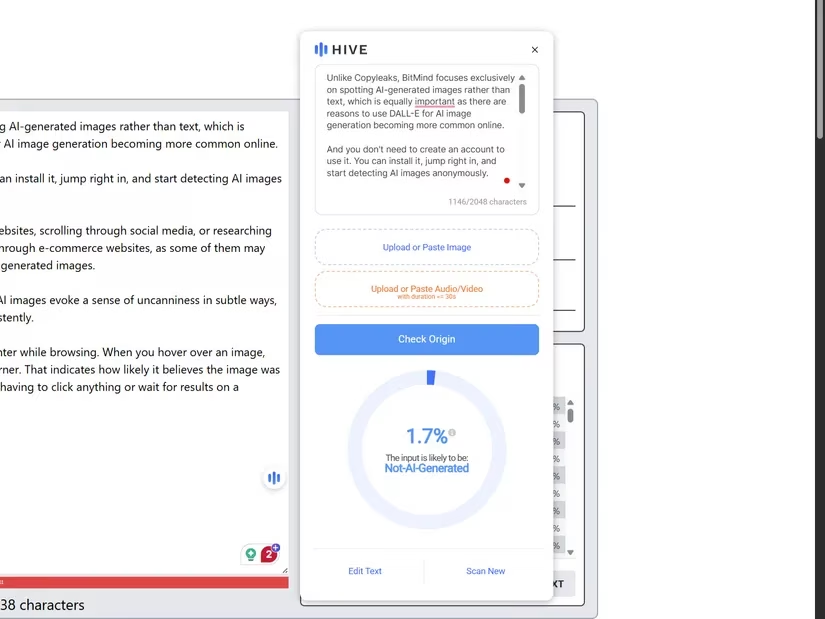
Taking a more holistic approach, the Hive AI Detector stands out by embracing not just text and images but also short audio and video clips up to 30 seconds in length. Its versatility eliminates the need for multiple single-purpose extensions. Access methods are flexible: highlight text and choose “Hive AI Detector” from the right-click context menu, or summon a draggable sidebar where content can be pasted directly, accepting chunks of up to 2,048 characters. For images, the same right-click option sends the visual off for analysis. What sets Hive apart is its attempt to identify the exact generative model responsible for a piece of content, presenting results wrapped in a confidence percentage. This additional layer of detail has proven handy for researchers tracking the spread of specific AI families. Like its competitors, Hive is not immune to confusing outputs; some scans return results that feel contradictory, reflecting the inherent hit-or-miss nature of today’s detection technology. Nevertheless, the extension requires no account or email address, preserving privacy while delivering robust multi-modal scanning. This friction-free design encourages widespread adoption, especially among users who value anonymity alongside accuracy.
In an era where deepfakes, fabricated reviews, and synthetic news articles proliferate with alarming ease, these Chrome extensions provide a valuable toolkit for the modern web surfer. Copyleaks delivers focused text scrutiny, BitMind excels at image interrogation, and Hive offers a Swiss Army knife of multimodal detection, all without requiring a steep learning curve. Yet it is vital to remember that even the best algorithms remain imperfect. False positives, missed synthetic content, and occasional glitches are inevitable companions on the road to a more transparent internet. The wisest strategy is to treat these tools not as final arbiters but as digital companions that sharpen, not replace, human judgment. Trust what you see, but always verify; that philosophy remains the bedrock of safe and informed browsing in 2026.