
For nearly two decades, web browsers had a dirty little secret: your browsing history could leak through the humble purple link. You know the one. You search for something, click a result, and later that same link shows up purple because you have been there, done that. It is a handy visual cue, but for 20 years it was also a gift to nosy websites. As of 2026, Google Chrome has finally slammed that door shut, and the fix is so simple it is a wonder nobody did it sooner.

The problem predates Chrome itself. When a browser marks a link as :visited, it changes its color to purple. But it used to render that color change no matter where the link appeared. That meant a malicious site could write clever JavaScript to check which links turned purple and, in doing so, reconstruct your browsing history. Even if you thought you were browsing privately, the purple trail could give you away. Firefox tried to limit which CSS styles could apply to :visited links and blocked JavaScript from reading them. Safari brought in Intelligent Tracking Prevention. But neither solution blocked every attack. The bad guys could still find a way to peek.
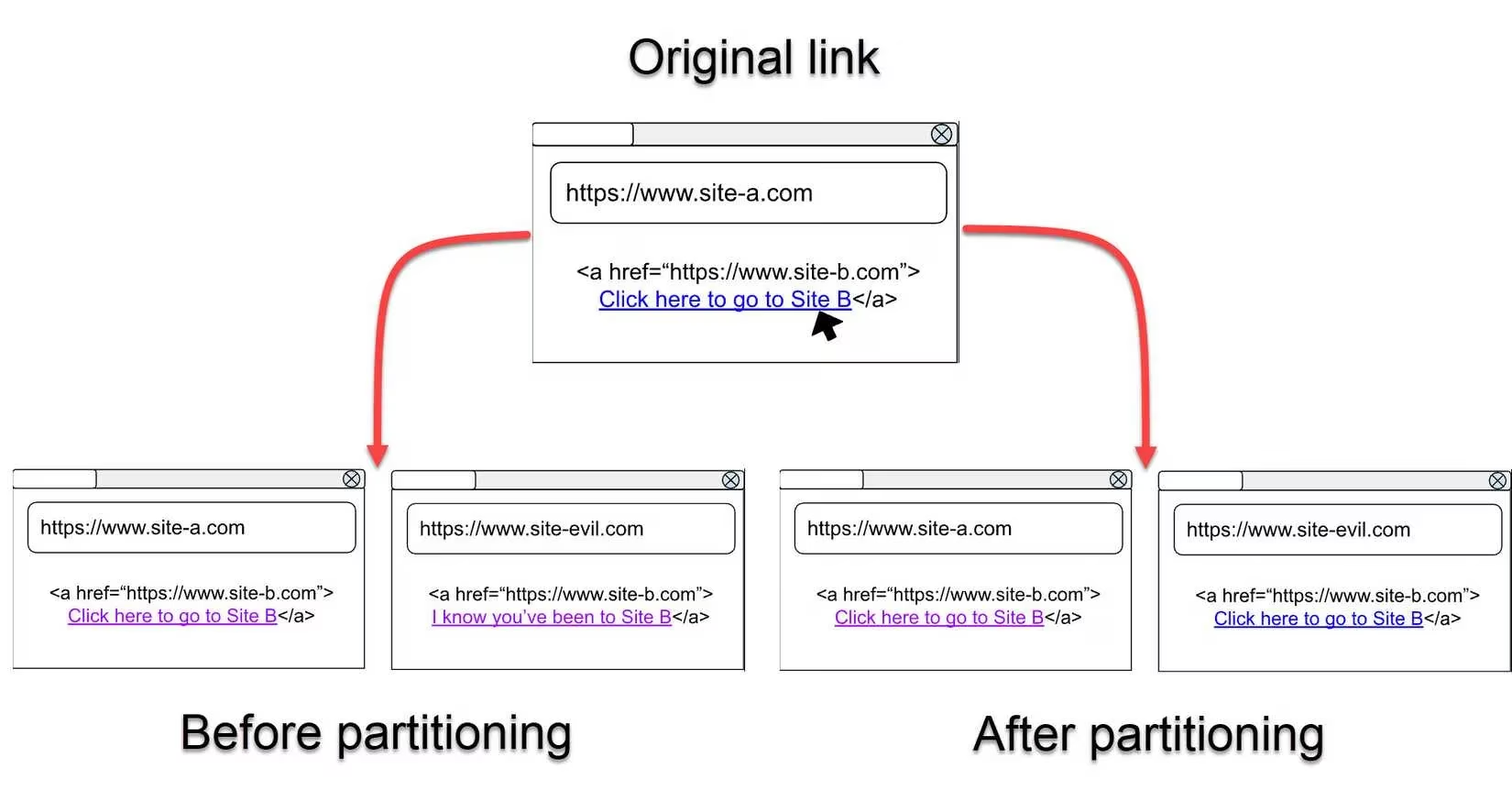
Enter Chrome 136. Google's Kyra Seevers explained in a blog post that Chrome is the first major browser to render these attacks obsolete. The trick is called link partitioning. Instead of storing link visits globally, Chrome divides each visited link into three parts:
-
Link URL
-
Top-Level Site
-
Frame Origin
In plain English, a link only shows up as visited on the same site and in the same frame origin where you originally clicked it. There is a 'self-links' exception, which means a site's own internal links will still be marked visited even if you clicked them from somewhere else. But a random blog cannot check whether you have visited your bank, your favorite forum, or that suspiciously specific search result from last Tuesday. The browser's memory is now compartmentalized, and the snoops are left out in the cold.
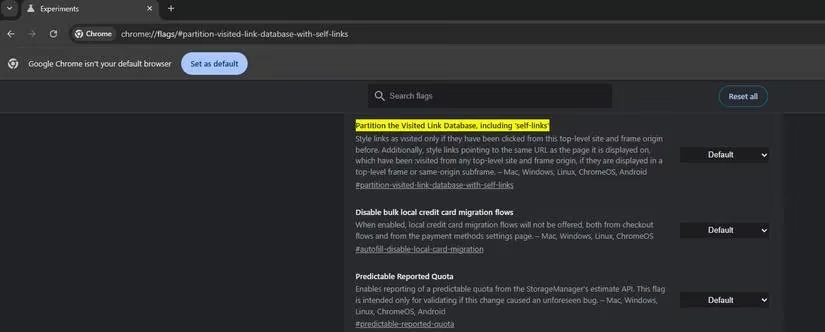
When Chrome 136 first landed, it was not immediately stable for everyone. The feature had been hiding behind an experimental flag since Chrome 132. If you were the adventurous type, you could enable it by pasting a special address into Chrome's URL bar and flipping the flag to Enabled. That flag was called partition-visited-link-database-with-self-links. It might have broken a few pages that tried to access your browsing history, but that was kind of the point. By 2026, Chrome 136 is ancient history in browser years, and the partitioning behavior is enabled by default. No flag-flipping required. The old functionality has not been completely deprecated, though. Google says removing it entirely would erase valuable user interface clues. So the purple link lives on, just with a much smaller blast radius.
For Chromium-based browsers, the story has been a bit of a waiting game. Since Chrome is the big kid on the block, many Chromium browsers eventually inherit its privacy improvements. But 'eventually' can feel like forever when you are waiting for a fix. In the meantime, users can check whether their browser supports the feature. If it does, great. If not, they can either be patient or switch to Chrome. By 2026, most mainstream Chromium browsers have caught up, but there are always a few stragglers.
Let us put it in perspective:
| Before link partitioning | After link partitioning |
|---|---|
| A visited link turned purple everywhere. | A visited link turns purple only where you clicked it. |
| Any website could probe your history with JavaScript. | Cross-site history probing is rendered obsolete. |
| Privacy fixes were partial Band-Aids. | The attack surface is basically gone. |
Is this the end of all browser fingerprinting? Not by a long shot. The web is still a wild west of trackers, cookies, and creative workarounds. But this is a big win. It is a rare case where a simple architectural change solves a problem that has been around since the days of Internet Explorer and early Firefox. Hats off to Google for finally putting the :visited leak out to pasture.
So next time you see a purple link, give it a little nod. It is no longer a snitch. It is just a friendly reminder that you have been there before, and nobody else gets to know. In 2026, that is a privacy upgrade worth celebrating. 🍾
Details are provided by CNET - Gaming, and they help frame why Chrome’s link-partitioning change matters even for everyday gaming browsing—like checking patch notes, guides, or forum threads—because it limits how easily third-party pages could infer what you previously clicked via the old :visited styling behavior, keeping routine research from quietly turning into a cross-site privacy signal.