
I spent years treating a VPN as the default answer to every privacy question. If I wanted to hide my IP address, avoid a snooping network, or feel more secure on public Wi-Fi, I opened my VPN app, picked a server, and told myself I was being careful. By 2026, I have changed that habit. I quit relying on VPNs as my everyday privacy tool and moved to Brave’s Private Window with Tor. It is not perfect, and it is not a magic cloak, but it fits the way I actually browse: quickly, often, and without wanting to manage another subscription.
My reasons for leaving VPNs were not dramatic. They were practical. I was drawn in by the promise of anonymity, better security, and access to content from anywhere, but the reality often felt heavier than the benefit. The first issue was trust. Not every VPN provider is transparent about what it does with user data. Some have been caught logging activity despite advertising a no-logs policy. I remember the 2022 discussion around NordVPN updating its terms to explain when it would comply with law enforcement requests, which made me question how absolute those privacy claims really were. Even if a provider is acting legally and responsibly, I do not like relying on a middleman whose promises I cannot easily verify.
Cost was another sticking point. Free VPNs often come with data caps, ads, or worse, unclear data practices. Premium VPNs are more reliable, but they can be expensive, especially when I am paying for features I rarely use. For someone who mostly wants to browse without being tracked by every advertiser, a full VPN subscription started to feel like overkill. Complexity made it worse. Setting up and managing a VPN is not always hard, but it is another app, another account, another set of settings, and another thing to troubleshoot when a connection fails. I wanted privacy to be a habit, not a small IT project.
That is what led me to Brave’s Private Window with Tor. It works like a mini Tor browser inside Brave. Instead of simply hiding my IP address the way a VPN does, it routes my traffic through the Tor network, encrypting data and bouncing it through multiple volunteer-run servers before it reaches its destination. That makes it much harder for websites, advertisers, and my internet service provider to follow what I am doing.
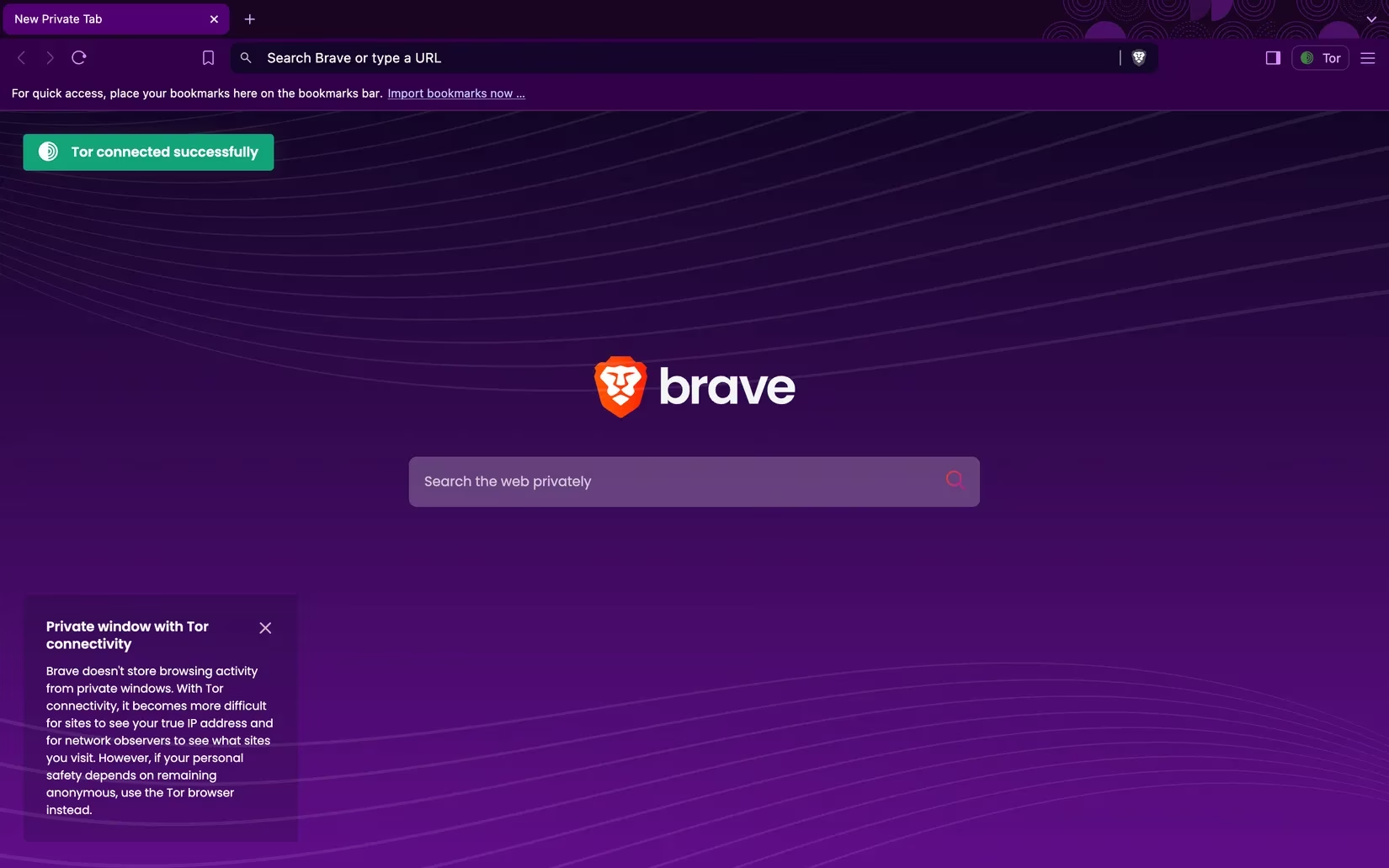
What I appreciate most is how effortless it feels. I do not need to install a separate app, log in, choose a server, or think about a subscription. I open a Private Window with Tor, and I am connected. A few clicks, and the privacy layer is there. For everyday browsing, that simplicity matters more to me than a long list of advanced options I will never touch.
I also try to manage my expectations. Brave’s private tabs do not offer the full anonymity of the Tor Browser. Brave’s implementation does not isolate a browsing session as thoroughly as the Tor Browser does, so there is still a small risk of fingerprinting. For high-stakes anonymity, I would not treat it as a complete replacement. But for ordinary tasks, the level of privacy is more than enough. I use it for quick research, reading news, sensitive searches, and general browsing where I do not want to be followed by ads.
| What I need | VPN | Brave Private Window with Tor |
|---|---|---|
| Quick private browsing | Requires an app, account, and server choice | Opens in a few clicks |
| Everyday privacy | Strong, but often overkill | Sufficient for most casual use |
| Streaming and gaming | Faster and more reliable | Not designed for speed |
| Trust model | Depends on a third-party provider | Open-source browser with no VPN middleman |
| Cost | Subscription or free-tier tradeoffs | No separate subscription |
Trust is another reason I stay with Brave. A VPN asks me to rely on a company to protect my data. Many providers claim they keep no logs, but those claims are not always easy to verify. Brave is open-source and privacy-focused, and it does not put a VPN provider between me and the network. That transparency gives me more confidence that my data is not being logged or sold.
I still recognize what VPNs do well. They are faster than Tor, which makes them better for streaming, gaming, and large downloads. They also offer more server locations, which is useful for bypassing geo-blocks. But those strengths matter less to me for daily browsing. In 2026, I want privacy tools that fit into my routine without turning every browsing session into a configuration task. Brave’s private tabs strike that balance for me. They are not a universal solution, but they are my default now. 😊